



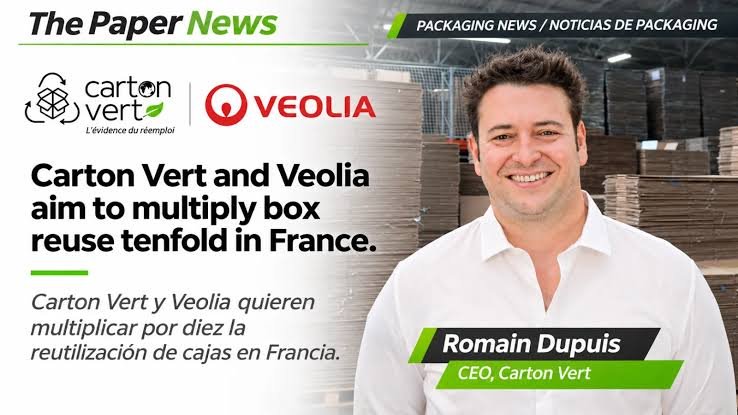
Veolia and Carton Vert have signed a 24-month national agreement to expand the recovery and resale of used corrugated boxes in France, aiming to multiply their volume by ten by 2029.
he corrugated packaging industry has traditionally viewed the end-of-life of a box through a single lens: fiber recycling. However, a renewed 24-month national agreement between Veolia and Carton Vert in France is shifting this paradigm by inserting a commercial reuse phase before the pulper.
The partnership aims to multiply the volume of reconditioned boxes by ten by 2029. Carton Vert, founded in 2020, has already processed over 14 million boxes, representing approximately 7,000 tons of material diverted from immediate recycling and saving equivalent CO2 emissions.
Sorting and secondary market economics
Under the expanded agreement, used boxes are collected and routed to Carton Vert’s sorting centers in La Rochelle, Grenay, and Cambrai. Here, they are inspected, sorted, and reconditioned for the secondary market. These boxes are then sold to French businesses at a 30% to 50% discount compared to newly manufactured corrugated packaging.
Guillaume Dury, Director of Corporate Services for Veolia France, and Romain Dupuis, CEO of Carton Vert, emphasize that reuse is an immediately deployable operational solution. For the corrugated sector, this introduces a new variable. While recycling rates in Europe are exceptionally high, the energy and water required to repulp and manufacture new testliner or fluting are significant. Extending the lifecycle of a box through direct reuse lowers the overall carbon footprint and offers a cost-effective alternative for logistics and e-commerce players facing margin pressures.
A structural shift in the supply chain
As the European packaging market navigates stricter environmental regulations and fluctuating raw material costs, the Veolia and Carton Vert model tests the viability of a secondary market for corrugated board. If the tenfold growth target is met by 2029, commercial box reuse could transition from a niche circular economy initiative to a standard operational tier within the broader packaging supply chain.
Source : thepaper.ai
