



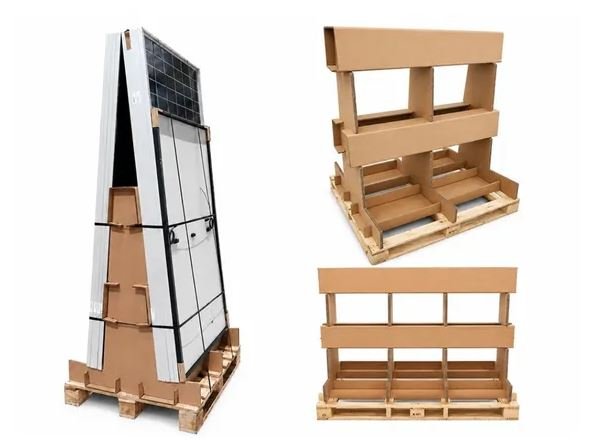
Alfilpack has developed an industrial packaging frame designed to hold solar panels vertically, improve load-space efficiency and protect modules in transit.
An alternative for large-format loads
Alfilpack has unveiled an industrial packaging system for transporting large solar panels. Reported on 12 November 2026, the development addresses a particular logistics problem: limited load-space utilisation when photovoltaic modules have to travel horizontally. The company says that arrangement can restrict stacking to a single layer, leaving much of the available capacity in lorries and shipping containers unused. Its alternative positions the modules vertically inside a supporting frame, with fastening elements designed to keep them in place. This is an innovation in industrial transport packaging rather than a new photovoltaic technology or a change to how solar electricity is generated. It is relevant to the supply chain because the safe arrival of large, delicate products depends on handling and load configuration as much as the product itself.
Using vehicle capacity more effectively
The central design change is the orientation of the load. Instead of laying panels across horizontal surfaces, the system arranges them upright in a supporting structure. According to Alfilpack, this configuration makes it possible to accommodate more panels in a single shipment and could reduce transport costs per module. The claimed environmental opportunity follows from carrying more products with fewer journeys or making better use of the available cargo volume. Nevertheless, the published information does not state a universal number of panels per container, a quantified freight saving or independently verified emissions reductions. Outcomes depend on module dimensions, the vehicle, weight limits and the details of the distribution route. Any comparison should therefore use equivalent shipments and take the full operation into account.
Mechanical retention and protection
Alfilpack says that the structure mechanically secures each panel, helping to absorb vibration and prevent rubbing between surfaces during travel, loading and unloading. These considerations are important for large-format products that can be vulnerable to unwanted impacts and contact. The system is described as having a lower base that serves as the support and anchoring point for assembly. Vertical elements are attached to the base to transmit loads and connect the structural components. Horizontal cross-members provide stiffness and distribute stress more evenly. Together, these features are intended to restrict movement without relying exclusively on external straps or pressure. Performance against vibration, impact and handling events should still be verified with tests suited to the shipping route and the actual product. The announcement does not provide a numerical damage-rate reduction.
Recyclability and material selection
The company describes the framing system as made from 100% recyclable materials, with components that can be separated after use. It also connects the development to more efficient use of raw materials and the European Packaging and Packaging Waste Regulation, generally known as the PPWR. The term recyclable should not be confused with a guarantee that recycling will take place. Effective recovery depends on the precise materials, local collection and sorting arrangements, and the way the frame is dismantled at the end of its service. Similarly, any statement of regulatory compliance needs to be considered against the provisions that actually apply, their implementation dates and the documentation for the finished packaging. No complete lifecycle assessment is included in the available announcement, so broader environmental comparisons cannot be calculated from it.
Questions for logistics operators
Manufacturers, distributors and freight operators considering this system must evaluate load density, security and handling time together. A vertical frame can change packing sequences, lifting requirements, load stability and unloading procedures. Compatibility with different module formats and road or maritime load-restraint rules is also relevant. The acquisition cost of the structure, its durability, potential reuse and the eventual destination of its components affect the business case, but the reported information does not quantify these variables. Pilot shipments would allow operators to compare the number of units carried, transit damage, handling hours and packaging expenditure against their existing solution. This is particularly important where apparent volume gains may introduce additional constraints elsewhere in the operation.
Packaging engineering in renewable-energy supply chains
The launch demonstrates the role that specialised packaging engineering can play in renewable-energy equipment distribution. Delivering modules intact requires a suitable combination of structural support, load restraint and careful handling. Alfilpack presents vertical positioning and mechanically secured framing as a coordinated response to poor vehicle utilisation and the risks of movement during transport. Its wider significance will be determined by measured units per shipment, damage rates, total costs and the management of packaging materials after use. The case underlines why shipping packaging should be evaluated as part of the logistics system rather than merely as an item consumed alongside the product. The potential gains are credible design objectives, but they remain dependent on testing and implementation.
