



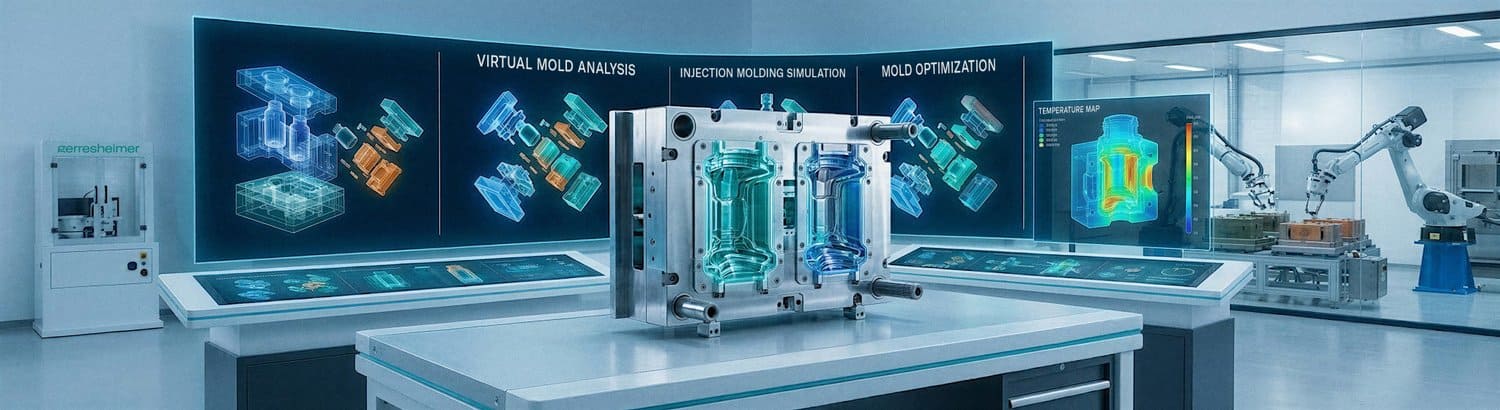
Gerresheimer, an innovative system and solution provider and global partner for the pharma, biotech, and cosmetics industries, is setting new standards in medical technology mold and process development with “Digital Mold.” With “Digital Mold,” the company is designing an end-to-end, data-driven process for the development, optimization, and operation of injection molds in medical technology. This enables mold development to be made significantly more efficient, transparent, and reliable. The combination of a virtual mold model (digital twin) and real production data (digital shadow) creates a consistent database spanning the entire lifecycle, which can also be utilized for data analytics and AI applications. For pharmaceutical and medical technology companies, this means reduced development risks, faster time-to-market, and stable, reproducible component quality.
“With Digital Mold, we are creating additional transparency and significantly greater process reliability for pharmaceutical companies throughout the entire mold development process,” says Stefan Schumann, Team Lead for Lifecycle Management & AI Engineering Molds at Gerresheimer Regensburg GmbH. “Through early-stage virtual analysis, we can shorten development times, reduce optimization loops, and at the same time significantly increase the quality and reproducibility of subsequent series production.”
From the virtual model to process-reliable mold development
A central component and technological driver of the Digital Mold is the concept of “Virtual Injection Mold and Process Development and Optimization” (VIMP). This system-supported and systematic approach makes it possible to develop and optimize mold design, as well as mold development and optimization processes, in parallel even before the physical mold is built. The “Digital Master” serves as the starting point for this digitally supported development. With the help of this digital twin, the mold is continuously refined and precisely adjusted throughout the entire development process. For customers, the use of VIMP results in well-founded, holistically thought-out mold development with a focus on process-reliable, dependable, and high-performance component production. The long-term goal is to significantly reduce time- and cost-intensive optimization cycles in mold manufacturing. At the same time, a transparent, validatable process foundation is created that meets, in particular, the high regulatory requirements in medical technology.
Mold Lifecycle Management as the foundation for AI applications
In industrial practice, Gerresheimer specifically applies the VIMP methodology where it offers the greatest technological and economic value. The areas of application range from feasibility assessments during mold design and development to simulation-based mold temperature optimization and material and construction analyses. Virtual DoE (Design of Experiments) also provides valuable insights and parameters for subsequent real-world injection molding prototyping. In addition to the technical design and development of production molds, Gerresheimer’s “Lifecycle Management & AI Engineering Molds” department also focuses on the systematic digitization of data, existing information, and experience. This data forms the basis for Gerresheimer’s comprehensive mold lifecycle management and is a prerequisite for advanced data analytics and AI applications. This enables the optimization of mold development and qualification in terms of time and cost-effectiveness, while unlocking potential for increased efficiency in production.
Use of the latest technologies and scientific collaboration
Gerresheimer is one of the leading providers of mold and process development in the medical technology sector. The company actively identifies new technologies in the fields of mold and process development, as well as the qualification and validation of injection molds. The specialized department collaborates with leading research institutions and universities in Germany, including RWTH Aachen University, the Institute for Plastics Processing (IKV), the Laboratory for Machine Tools and Production Engineering (WZL), and Eastern Bavarian University of Applied Sciences (OTH) Amberg-Weiden. This network enables the company to test innovative approaches in practice at an early stage and translate them into industrial applications. With Digital Mold and Mold Lifecycle Management, Gerresheimer once again underscores its position as an innovative partner to the pharmaceutical and biotech industries.
