



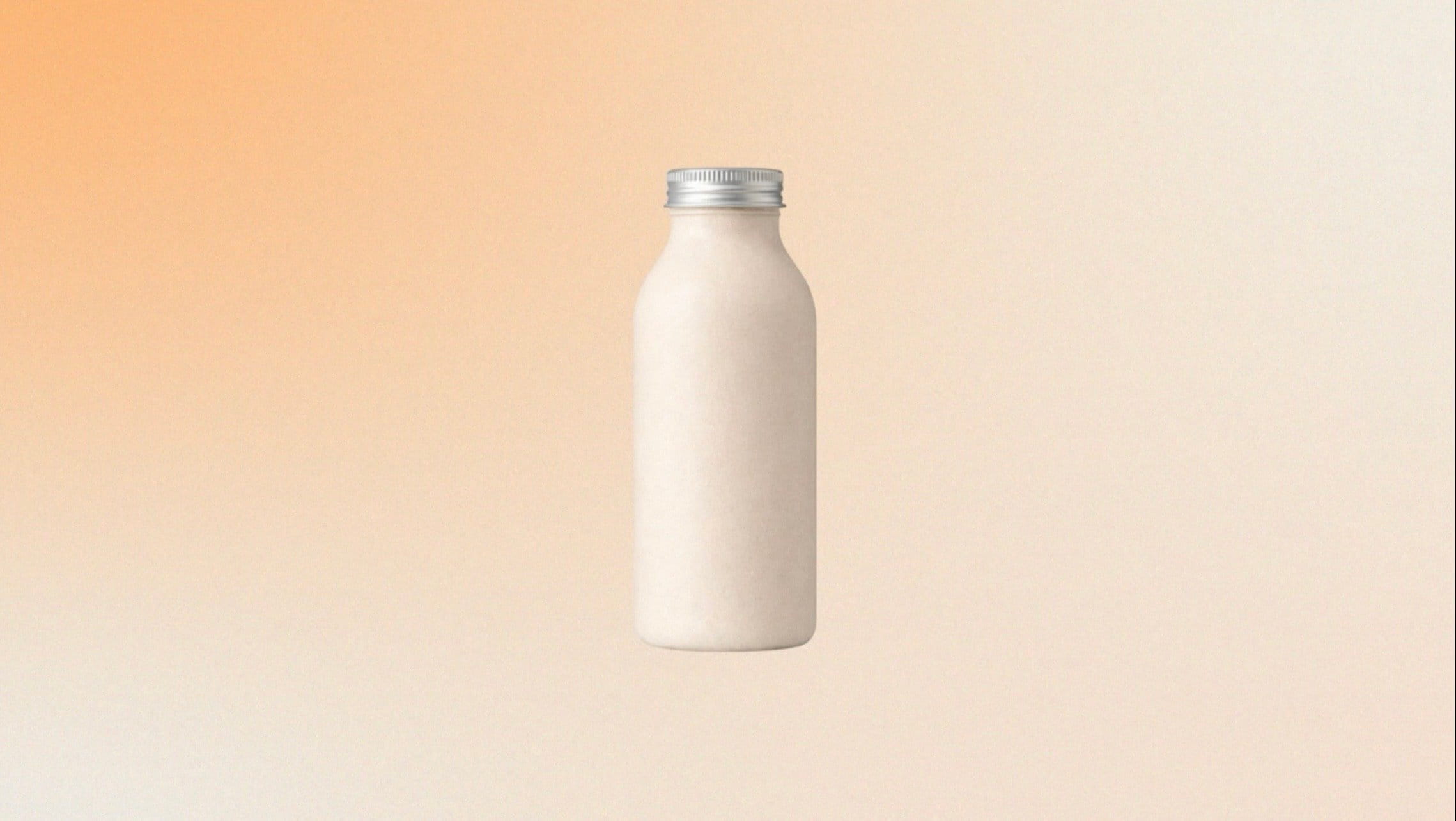
Currently, containers used in consumer packaged goods are mostly made of plastic, while some premium brands use aluminum or glass.
We’ve developed a biomaterial made from plant fibers and natural waxes for packaging. Our material enables rigid packaging in any shape, size, or color across industries such as food, beverages, home care, beauty, and personal care, replacing single-use plastics in these applications.
Problem
Packaging is one of the biggest contributors to global plastic waste. Many alternatives, like bioplastics, can shed microplastics and require industrial composting. Paper bottles are a new emerging solution, but they have hidden plastic linings or bioplastic coatings, often greenwashed as “bio-based coatings,” and hence cannot be called plastic- or microplastic-free.
In contrast, our material eliminates the need for any plastic or synthetic coatings entirely.
Material
Phyber™ is a biomaterial composed of plant fibers and a natural wax-based barrier. It uses plant fibers derived from agricultural waste such as sugarcane, which form a dense, interlocked structure that provides the strength and rigidity required for packaging containers.
A proprietary natural wax-based barrier is integrated into the material to provide resistance to moisture and oxygen, enabling barrier performance needed for most packaging applications, including liquids, creams, powders, and more.
The material also offers high design flexibility and can be molded into packaging of any shape, size, and color, with compatibility for printing and branding, enabling plastic-free packaging across a wide range of formats.
Process
The plant fiber pulp is converted into a slurry by combining it with water and selected additives, then poured into molds of the desired size and shape. Our material enables the formation of a single-piece structure, overcoming the current limitation of two-piece molded fiber used in the industry. After molding, the structure is impregnated with the natural wax-based barrier system.
One of the key challenges with paper or fiber containers is that fibers are hygroscopic, meaning they absorb moisture and expand or contract, which can cause conventional coatings to crack over time.
We solve this by using an emulsion-based system, where wax particles are reduced to very fine micron-scale sizes and deeply impregnated into the fiber structure. This allows the wax phase to penetrate the fiber network, effectively stabilizing it and reducing dimensional changes. As a result, the issue of microcracks is addressed, enabling long shelf life.
A patent covering the manufacturing process has been filed and is currently pending.
Capabilities
WVTR and OTR levels support up to 12-month shelf life for most products.
Containers made from Phyber™ are designed to run on standard filling lines and are compatible with existing caps and closures, enabling integration into current packaging systems without requiring significant changes to infrastructure.
The material uses inputs from existing supply chains, enabling faster scale-up and supporting cost-competitive pathways.
Applications
Phyber™ can be used to create packaging in various shapes and formats, including bottles, jars, cups, tubes, and other rigid containers.
It can be applied across industries such as food and beverages, home care, beauty and personal care, cosmetics, laundry, supplements, condiments and sauces, powders, and other consumer packaged goods.
Material Safety & Compliance
The material is composed without fossil-based plastics or bioplastic equivalents and is designed to be free from petrochemicals, PFAS, BPA, and phthalates.
Unlike conventional plastic packaging, which can release microplastics and chemicals into the contents, the material is microplastic-free and designed to meet safe migration limits in line with EU and FDA standards.
It is non-toxic, non-reactive, and inert in contact with packaged products.
Sustainability
Since the material consists only of natural waxes and plant fibers, it can be easily composted and is designed to biodegrade in natural environments. Even without controlled disposal systems, the material can break down through natural biological processes such as moisture, microbial activity, and environmental exposure, without leaving behind persistent residues or microplastics.
We use plant fibers from agricultural waste such as rice straw and bagasse, which are usually discarded or burned by farmers. This helps significantly reduce emissions while utilizing waste as a feedstock.
It also helps brands meet regulatory requirements and consumer demand for plastic-free packaging.
Why This Is a Big Deal
Plastic still dominates packaging because nothing else has been able to match its durability, barrier performance, and shelf life, especially for liquids. This material breaks that dependency by delivering the same performance without using any form of plastic, enabling truly plastic-free packaging at scale.
Current Stage
Zerolys has developed working prototypes, and the material is progressing from lab-scale development to pilot-scale production.
About Zerolys
Zerolys is a materials technology company founded in 2024 and headquartered in Mumbai, India. Our mission is to accelerate the global shift away from plastics toward better materials. We believe in the power of material science to solve the plastic waste challenge and drive meaningful and lasting change for the environment.
