



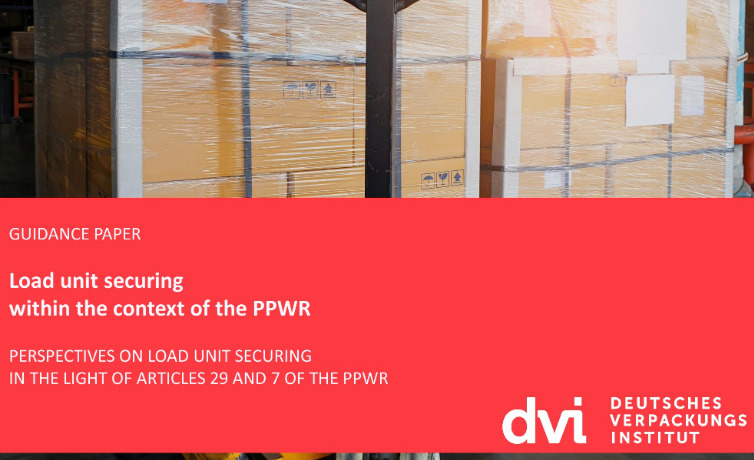
From 12 August 2026 onwards, the new European Packaging and Packaging Waste Regulation (PPWR) will gradually become binding and applicable in all EU member states. Among the new requirements that must be implemented by 2030 are reuse and minimum recycled content quotas for transport packaging, including strapping bands and flexible pallet wraps made of plastic and paper. Since the new regulations raise many questions and create uncertainties in the packaging industry, particularly regarding load unit securing, the German Packaging Institute (dvi) has developed a guidance paper on load unit securing. This paper summarizes the current regulatory requirements, existing challenges, and potential solutions.
“The guidance paper on load unit securing provides companies with a practical and technically sound overview in the context of Articles 29 and 7 of the PPWR. We have deliberately focused on practical application: beginning with a definition of load unit securing and the legal framework, followed by an explanation of reuse and recycled content quotas, and concluding with a summary of key challenges and possible solutions,” explains dvi Managing Director Dr. Natalie Brandenburg.
The legal framework: Articles 7 and 29
Pursuant to Article 29(1), transport packaging, including strapping bands and flexible pallet wraps made of plastic and paper, must meet a reuse target of 40% from 2030 onwards. With regard to Articles 29(2) and 29(3) of the PPWR, a delegated act of the European Commission provides for strapping bands and pallet wraps to be exempted from the originally envisaged obligation of a 100% reuse rate. In parallel, Article 7 stipulates minimum recycled content requirements where no explicit exemptions apply. For example, the minimum post-consumer recycled (PCR) content for plastic stretch films and strapping bands is set at 35% from 2030, increasing to a minimum of 65% from 2040.
Innovation needs for reuse systems
“At present, no reusable alternatives are available for load unit securing that could replace single-use strapping and films in automated processes. Even in the area of transport packaging, where practicable reusable solutions already exist, large-scale implementation remains a challenge. In our position paper, we provide an overview of these issues and highlight the need for innovation — ranging from standardization and system integration to empty-container management, handling and logistics, as well as feasibility, economic viability, traceability, and digitalization,” said Natalie Brandenburg.
Recycling instead of reuse
As technically and economically viable reuse options for stretch films and strapping bands in automated processes are lacking, and studies have at the same time demonstrated the ecological advantages of single-use load unit securing, the authors of the guidance paper advocate the establishment of suitable recycling loops as an alternative to reuse targets and as a more effective way of achieving the overarching objectives of the PPWR.
Challenges in PCR implementation
In order to meet the required recycled content quotas, the industry must take an integrated approach, according to the dvi committee. Major challenges remain in ensuring a reliable and traceable supply of raw materials as well as sufficient recyclate quality. Further innovation and optimization are also needed to maintain the required material performance despite high recycled content levels. Last but not least, specific recycling solutions—particularly with regard to closed-loop systems—must be further developed and scaled up.
Source and dvi committee
The Load Unit Securing Committee of the German Packaging Institute (dvi) was consulted in the preparation of this guidance paper. “Within the committee, we bring together business practice and technical expertise from around 20 companies representing all stages of the value chain – from material production and packaging development to logistics and application – in order to give equal consideration to technical, environmental, economic, and safety-related aspects of load unit securing. The involvement of dvi members representing all relevant packaging materials and systems also ensures a consistently cross-material perspective. In addition, we have incorporated external input, for example from EUMOS (European Safe Logistics Association),” explains Natalie Brandenburg.
