



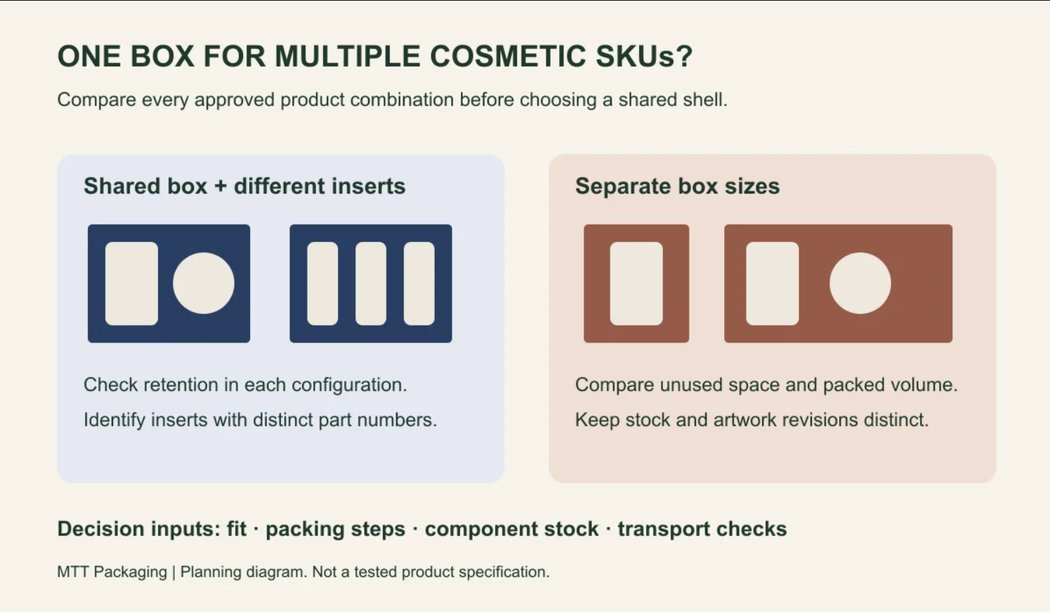
Standardizing a presentation box does not automatically simplify the stock behind it. Buyers should evaluate complete packable sets, insert compatibility and revision controls before consolidating box sizes.
A purchasing team may choose one presentation box for several product combinations to reduce the number of outer-box references. That decision can still leave multiple inserts, sleeves and cards in stock. Before calling the range simpler, ask a more useful question: how many complete, approved sets can the available components actually produce?
Count complete configurations
A shared shell is only one line in the bill of materials. Each sellable configuration needs its correct insert, products and accompanying items. If one insert runs out, spare shells cannot necessarily fulfil that configuration. Conversely, ordering every insert against the total shell quantity can leave dedicated components without a matching demand.
Build the forecast by sellable combination first. Then translate it into component quantities, identifying which parts are shared and which are dedicated. Keep assumptions about spare stock explicit. This is a purchasing control, not a claim that common packaging always reduces material use or cost.
Make compatibility a recorded decision
Similar-looking containers are not automatically interchangeable. A change in closure height or bottle decoration can affect clearance or the permitted contact area. An insert that accepts the new container may still hold it poorly or make removal difficult.
Maintain a short compatibility record: product reference, insert reference, outer-box reference and approved packing photograph. Give revised parts distinct identifiers. The objective is to let a packer recognize a valid combination without making an engineering judgement at the packing table.
Separate cosmetic updates from physical changes
When artwork changes, decide whether the old and new components may be mixed. A structurally compatible insert may still carry an outdated instruction or product name. A new container, meanwhile, deserves a review of fit even if the printed box remains identical.
Use three disposition categories: approved for current use, reserved for a named configuration, and held pending a decision. Do not treat held stock as immediately available production material. Record who can release it and what evidence is missing. This makes unresolved stock visible without assuming it should be discarded.
Compare the full packing operation
Before committing to a shared shell, run a small packing trial with the proposed components and draft work instruction. Note where component identification is ambiguous, where a wrong part can be fitted, and which steps require explanation. Those observations can justify a clearer identifier or a different layout before quantities are fixed.
Also compare packed shipping dimensions, handling and the stock required by each configuration. A larger shared box might be appropriate, but its logistics should be measured against the separate-size alternative. Avoid converting fewer component references into an unsupported percentage saving.
Keep the benefit specific
The useful outcome is a range that the team can order, assemble and revise reliably. Reducing obsolete stock is a sensible objective; proving an environmental improvement requires evidence beyond a smaller parts list. Keep any public sustainability statement separate from the internal inventory rationale.
